Translated from French with the help of AI; the French text prevails.
White-winged snowfinch
White-winged snowfinch
Montifringilla nivalis
Zone
Nival
Altitude
1900–3500 m
Active period
all year
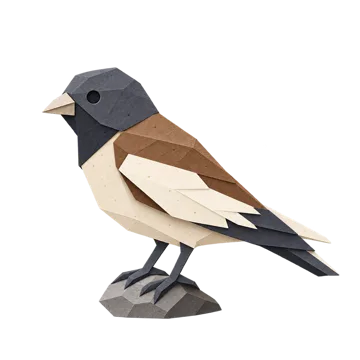
A small songbird with a grey head and a brown back that shows large white patches on its wings in flight. It lives above the tree line, on scree, ridges and around the huts. It nests in rock crevices, at heights few birds dare to reach.
In front of a hut, above the scree, small grey and brown birds peck between the stones. One of them takes off and turns almost white: the white-winged snowfinch was hiding large white panels on its wings and tail.
Description
It looks like a large sparrow. According to the Swiss Ornithological Institute, it measures 17 to 19 cm, with a wingspan of 34 to 38 cm and a weight of 32 to 47 g. The head is grey, the back brown, the belly whitish, and a black patch marks the throat. Its white wings have black flight feathers; the tail, also white, is black only in the centre. Females and young are duller.
Habitat
According to the Breeding Bird Atlas, it usually nests from 1900 to 3000 m, exceptionally up to 3490 m, and today never below 1600 m. Its well-insulated nest is tucked into a ski-lift pylon, under a chalet roof or in a rock crevice, close to grasslands rich in larvae. It is most abundant in the Grisons and the central Alps: a favourable square kilometre there often holds 8 pairs. In winter it moves only a little way down, and some even fly back up in the evening to sleep in crevices at around 3000 m.
Way of life
It feeds on seeds and insects. Its young are fed mainly on larvae, notably those of crane flies, which it picks at the edge of melting snowfields; indeed, it prefers to nest near lingering snow. A clutch has 4 or 5 eggs, incubated for 13 to 14 days, and the young fledge after 18 to 21 days. An adaptation to the cold: according to the Ornithological Institute, its embryos develop from 30 °C, compared with 35 °C in other birds.
In Switzerland
There are 5000 to 8000 pairs (2025 estimate), and the species is near threatened. Since the 1990s it has lost almost 15% of its numbers, especially in Valais, in the central Alps and below 2400 m; the Grisons have been spared. The cause is the climate: in 35 years, the snow has come to melt 26 days earlier on average, and hatching has not moved forward as much. According to a 2025 study, each extra degree brings the start of breeding forward by almost 5 days, and its end by more than 4. Moving higher has its limit: the summits. Switzerland is home to one in six European snowfinches.
Sources: Swiss Ornithological Institute, species account, text of the Swiss Breeding Bird Atlas 2013–2016 and press releases “Évolutions climatiques défavorables pour la niverolle” [Unfavourable climate trends for the snowfinch] (2023) and “Une course contre la montre” [A race against the clock] (2025).