Translated from French with the help of AI; the French text prevails.
Alpine ibex
Alpine ibex
Capra ibex
Zone
Alpine
Altitude
1600–3300 m
Position
Mostly on the adret
Active period
all year
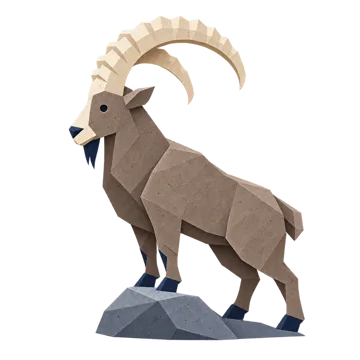
The male carries long horns curving backwards, ringed with ridges. The ibex lives among the rocks and meadows of the alpine zone and spends winter on sunny slopes, where less snow lies. Wiped out in Switzerland in the 19th century, it was brought back from 1911 with a few animals from the Gran Paradiso.
On a ledge that looks out of reach, an old male chews the cud, his long horns outlined against the sky. Lower down, females and their kids graze at the edge of the drop, seemingly unaware of the hikers.
Description
Both male and female have horns: up to about 110 cm in the male, 35 cm in the female, according to the Valais hunting service. The male weighs up to 100 kg, the female 45 kg. The horns grow longer throughout life, but their growth stops every winter; the animal’s age can therefore be read from the rings on the back of the horns, like the growth rings of a tree trunk. The hoof combines a hard rim, which catches on the slightest hold, with a soft sole that grips polished stone.
Habitat
A true inhabitant of the alpine zone, it almost never comes down into the forest, the Swiss National Park points out. In summer it occupies the rocks and high-altitude grasslands; in winter it moves to quarters lower down, sometimes after a long journey. It grazes grasses and other herbs, supplemented in winter with shrubs, roots and lichens. A winter of heavy snow and avalanches, or an epizootic, can decimate a colony.
Way of life
Males and females live in separate groups of ten to thirty animals. Among the females, the eldest leads the group; among the males, rank can be read from the length of the horns. They settle it from August onwards in jousts, so that by the rut in December the hierarchy is established and the fights take less out of them. After 24 weeks of gestation, a single kid is born in June. A female can live 24 years. The golden eagle preys mainly on the young.
In Switzerland
Hunted for the miraculous powers attributed to its body, it vanished from the Grisons as early as 1650, and the last ibex in Valais was shot in 1809. Its return began with smuggling. In 1905 the King of Italy turned down the Federal Council, which had asked him for animals from his Gran Paradiso reserve. The following year, according to the WSL, three animals were smuggled across the border. Raised in the Peter and Paul park in St. Gallen, their descendants were released from 1911. Today’s colonies descend from the 66 animals captured in the Gran Paradiso between 1906 and 1923, hence their low genetic diversity. Switzerland has nearly 19,000 ibex, more than a third of those in the Alps, according to the Bern University of Applied Sciences. Not threatened, it remains protected, but its colonies have been regulated by shooting since 1977, first in the Grisons.
Sources: info fauna, species account; Swiss National Park, ibex portrait; Valais Hunting, Fishing and Wildlife Service, factsheet “Le bouquetin” [The ibex] (2025); Waldwissen.net (WSL), “Bouquetins : une base génétique étroite” [Ibex: a narrow genetic base]; Bern University of Applied Sciences (HAFL), “Steinbock Stockhorn” project.