Translated from French with the help of AI; the French text prevails.
Rusty-leaved alpenrose
Rusty-leaved alpenrose
Rhododendron ferrugineum
Zone
Subalpine
Altitude
1500–2500 m
Position
Mostly on the ubac
Flowering
June – August
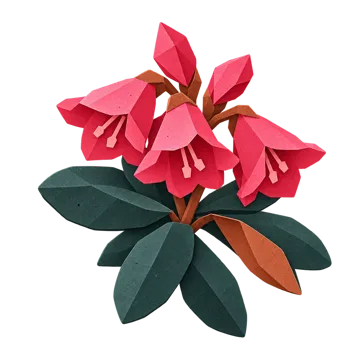
A shrub with clusters of purplish-pink flowers whose glossy leaves are covered underneath with rust-coloured glands. It forms dense heaths on shady slopes and acid soils, where snow shields it from frost for a long time. It needs that snow cover: it is found mostly on the ubac, the shady side.
In early July, above the forest, a whole north-facing slope turns pink. Among scattered larches and arolla pines, dense bushes are covered with clusters of flowers: the rusty-leaved alpenrose is in bloom.
Description
In German it is called “Alpenrose”, the rose of the Alps; yet it is a rhododendron, of the heath family. According to Info Flora, this shrub grows no taller than one metre. Its evergreen, leathery leaves measure 1.5 to 4 cm; their edges are rolled under and their upper side is a dark, glossy green. The underside, yellowish at first, becomes covered with rust-coloured glands, hence the name “rusty-leaved”. The purplish-pink flowers, about 1.5 cm long and speckled with rust on the outside, are grouped at the ends of the branches.
Habitat
It needs acid soil: Info Flora calls it calcifuge and reports it in dwarf-shrub heaths, high-altitude conifer forests and pastures, mainly in the subalpine zone, from the Alps to the southern Jura. It also needs snow. Without this winter blanket it would freeze, according to the German Alpine Club; its supple branches bend beneath it without breaking, CREA Mont-Blanc notes. Hence its preference for north-facing slopes, where snow piles up: a study carried out in Andorra (PLoS ONE, 2016) finds it mainly on those slopes.
Life cycle
It keeps its leaves all year round and flowers from June to August, according to Info Flora; its flowers give rise to five-chambered capsules. According to Christian Rixen of the SLF in Davos, snow keeps it dormant: if the snow melts too early, the shrub wakes up and frost can then damage it. Flowers, leaves and capsules are poisonous, swissinfo points out, and the German Alpine Club calls it dangerous for livestock. Farmers, who watched it spread over the alpine pastures, often cut it just above the roots.
In Switzerland
It is the most widespread rhododendron in the country, according to swissinfo. The Red List does not consider it threatened nationally, but vulnerable in the Jura and critically endangered on the Swiss Plateau. The Confederation does not protect it; seven cantons do, fully in Zurich and Lucerne, partially in Obwalden, in both Appenzells, in St. Gallen and in the canton of Vaud.
Sources: Info Flora, species accounts for the rusty-leaved alpenrose and the hairy alpenrose (after Flora Helvetica); CREA Mont-Blanc, species account; German Alpine Club (DAV), “Die Rostblättrige Alpenrose”; SLF, “Neige et myrtilles, un lien fragile” (2025); swissinfo.ch, “Alpenrose: not a rose but a rhododendron”; B. Komac et al., PLoS ONE, 2016.