Translated from French with the help of AI; the French text prevails.
Red kite
Red kite
Milvus milvus
Zone
Colline
Altitude
300–1600 m
Active period
all year
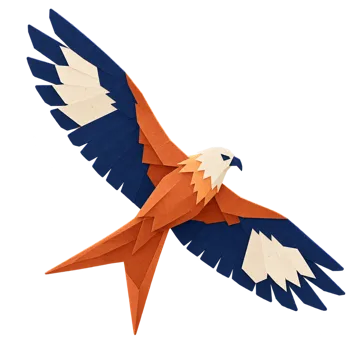
A large rufous bird of prey with a pale head, known in flight by its long, deeply forked tail. It soars over the meadows and fields of the Swiss Plateau and the hills, looking for small rodents. Switzerland is home to a large share of the world population, and many now stay for the winter.
Behind the mower, on a meadow on the Plateau, several large rufous birds of prey circle low, then land for a moment in the cut grass. Their long forked tails tilt at every turn: red kites.
Description
The plumage is rufous brown, the head pale, almost white, finely streaked, and the tail, a bright rufous, is cut into a deep fork. In flight, the long, slender wings show a marked bend, and a white patch lights up each of them. Male and female look alike. According to the Swiss Ornithological Institute, it measures 56 to 73 cm and reaches a wingspan of 140 to 165 cm, for a weight of 750 to 1300 g. A researcher counted the feathers of a red kite: 6170.
Habitat
It likes open, varied countryside and readily comes close to settlements. It nests in a large tree, often at the edge of a wood or in a copse. It is most numerous on the Plateau, below 800 m. According to the Swiss Breeding Bird Atlas, it reaches remarkable densities there: in 2017, between the Sense district and Schwarzenburg, 350 km² held 124 pairs. Since the 1990s, it has also conquered the main valleys of the Alps and nested as high as Davos, at 1550 m.
Way of life
Not fussy, it eats mice, earthworms, carrion and scraps, which it spots while circling over the fields. The female lays 2 or 3 eggs, incubated for about thirty days; the young leave the nest after 50 to 55 days. In the past, all the red kites of Switzerland wintered in Spain or Portugal. Almost all young birds migrate for their first winter, but with age most stay: only one adult in three still migrates. In winter the young, especially the males, spend the night together in roosts that sometimes gather more than a hundred birds; breeding birds sleep in pairs near their territory.
In Switzerland
With 3000 to 5000 pairs (2025), Switzerland is home to about a tenth of the world’s red kites, a species that breeds only in Europe. The species is not threatened according to the Red List, but its conservation is considered a priority. The red kite took over the whole Plateau in some forty years. According to the Ornithological Institute, this boom is thought to be due to more accessible food (prey exposed by earlier and more frequent mowing, animals run over on the roads), milder winters and feeding. The dangers remain: collisions and electrocution on badly designed power lines, poisoning, illegal shooting and, at the nest, twine in which the young can get entangled.
Sources: Swiss Ornithological Institute, species account, text of the Swiss Breeding Bird Atlas 2013–2016 and articles “Un oiseau de haut vol” [A high-flying bird] (2021), “Ceux qui partent et ceux qui restent” [Those who leave and those who stay] (2025), “Dortoirs royaux” [Royal roosts] (2026), “Le milan royal : de l’envol à la colonisation” [The red kite: from fledging to colonisation] (2016) and “Combien de plumes a le milan royal ?” [How many feathers does the red kite have?].