Translated from French with the help of AI; the French text prevails.
Red deer
Red deer
Cervus elaphus
Zone
Montane
Altitude
400–2400 m
Active period
all year
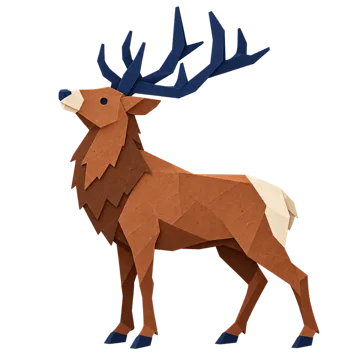
Switzerland's largest deer: the stag carries large branched antlers that it sheds every year at the end of winter. It lives in mountain forests and climbs to the alpine pastures in summer. In September and October the stags' roaring echoes through the valleys, above all at dusk and at night.
One autumn evening, a long, hoarse cry rises from the forest, and another answers it from the opposite slope: the stags are roaring and challenging their rivals.
Description
According to Waldwissen.net, it has been the largest wild mammal in Switzerland since the bear disappeared from the country. The adult stag stands between 1.2 and 1.5 m at the shoulder and weighs 170 to 220 kg; the hind weighs 90 to 130 kg. Red and short in summer, the coat becomes thicker and grey-brown in winter. Only the male has antlers, made of bone. He sheds them every year, and they grow back from March to July under a velvety skin that he then rubs against the trees.
Habitat
Mountain forest is its domain, and it is now spreading onto the Swiss Plateau. In summer, though, the Alpine red deer climbs above the tree line to graze the high meadows. As soon as the snow is deeper than 20 to 30 cm, it comes back down to the lower forests or the sunny slopes; in the Engadine, it covers 10 to 40 km in this way. The Swiss National Park hosts some 2000 of them, but only five months a year.
Way of life
Each hind stays in a herd with her calf and her yearling; the males keep to groups of their own, the oldest often alone. The roaring season lasts from mid-September to mid-October and generally peaks in the first days of October. A highly excited stag gives up to 500 roars an hour, almost stops eating and loses up to a fifth of his weight. Fights can kill, and it is often the fittest that wins, not necessarily the best armed, the National Park observes. In June a single calf is born, dappled with pale spots.
In Switzerland
Around 1850, hardly any red deer were left in Switzerland, apart from a few herds in the Grisons. The species came back of its own accord from 1870, from the Montafon in Austria, and five animals were released in 1926 in the Val Ferret in Valais. The Federal Hunting Statistics count just under 40,000 (as of 2025), and the species is not threatened. To keep their numbers stable, hunting has to remove 15 to 20% of them every year: when there are too many, red deer browse the young trees and strip the bark from others.
Sources: info fauna, species account; Swiss National Park, red deer portrait; Waldwissen.net (WSL), “Le cerf (Cervus elaphus)” [The red deer] and “La statistique fédérale de la chasse” [The federal hunting statistics].