Translated from French with the help of AI; the French text prevails.
Martagon lily
Martagon lily
Lilium martagon
Zone
Montane
Altitude
400–2300 m
Flowering
June – August
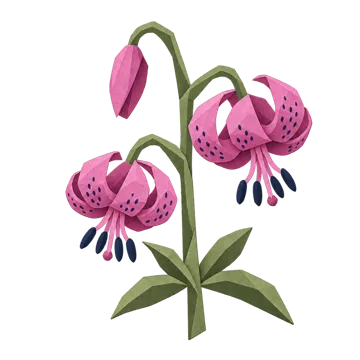
A lily with nodding pink-purple flowers spotted with dark marks, their petals rolled back like a turban. It grows in open woods and in mountain meadows rich in tall herbs. Its flowers smell sweet in the evening and draw moths. It is protected.
One July evening, beside a path in a mountain forest, a lone stem rises above the tall grass. Its flowers hang like small lanterns, their petals turned up towards the sky, pink and speckled with dark spots. At dusk, a moth comes to drink from them without landing.
Description
The martagon lily measures 30 to 90 cm, according to Flora Helvetica, as cited by Info Flora. Its stem, often spotted with red, bears many broad, pointed leaves; those in the middle form whorls of 4 to 8, which makes it recognisable even without flowers, the Naturzentrum Glarnerland notes. The flowers, 3 to 20 in a loose raceme, hang at the end of curved pedicels. Their six tepals, 3 to 4 cm long, light purple speckled with dark purple, curl backwards. The flower recalls a Turkish turban, called a “martagan”: hence its Latin name, and its German name, Türkenbund. Underground, a golden-yellow bulb made of many scales lets it survive the winter.
Habitat
Info Flora reports it in forests, especially beech and oak woods, in meadows and in megaforb stands, those formations of tall herbs, on limestone soil. It climbs from the colline to the subalpine zone, sometimes beyond. It is found in the Alps and the Jura, more rarely on the Swiss Plateau. In the canton of Glarus, it prefers damp forests and the tall herbs of steep slopes, at altitude.
Life cycle
It flowers in June and July. Its hanging flowers offer no foothold: bees and bumblebees can reach the nectar only by forcing their way in. It is pollinated by long-tongued moths, which hover as they feed. To attract them, the plant, which has little scent by day, releases its fragrance at nightfall, the Naturzentrum Glarnerland explains. In September, according to the University of Zurich’s veterinary database, a three-chambered capsule ripens, filled with flat, winged seeds.
In Switzerland
Although not rare, the martagon lily is protected throughout the country, and fifteen cantons also include it on their own lists. So it must not be picked, nor its bulb dug up: frequent picking would soon threaten its sites. The 2019 Red List rates it as not threatened, except on the Swiss Plateau, where it is near threatened.
Sources: Info Flora, species account (after Flora Helvetica); Naturzentrum Glarnerland, press release “Türkenbund gesucht”, 2025; University of Zurich, database of medicinal and poisonous plants of the Institute of Veterinary Pharmacology and Toxicology.