Translated from French with the help of AI; the French text prevails.
Cowslip
Cowslip
Primula veris
Zone
Colline
Altitude
200–2000 m
Flowering
March – May
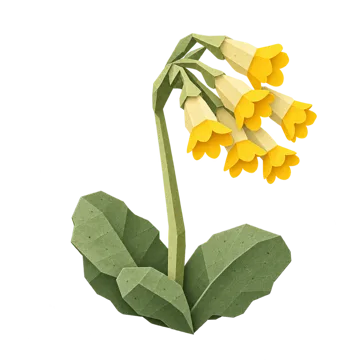
At the top of a stem it carries an umbel of golden-yellow, nodding bell flowers with a light scent. It blooms in spring in poor meadows and on banks, from the lowlands to the mountain pastures. It is protected in Thurgau, and partially in Obwalden.
In April, on a dry meadow where the grass is still short, yellow tufts stand up by the dozen. Each stem carries a bunch of nodding bells all turned to the same side, and you only need to kneel to catch their scent. These are cowslips, which many French speakers simply call “coucous”.
Description
According to Flora Helvetica, as cited by Info Flora, the plant measures 10 to 30 cm. Its oval, wrinkled, downy leaves form a rosette at ground level, and their blade narrows abruptly into a winged stalk. At the end of a bare stem, up to 20 flowers turn almost all to the same side. The golden-yellow corolla emerges from a swollen, angular calyx; each of its five lobes is marked with an orange spot at its base. The University of Zurich’s veterinary database distinguishes two subspecies in Switzerland, one of which, with leaves felted grey or white underneath, lives in woodland.
Habitat
Info Flora counts it among the plants of dry meadows, usually on limestone. The Research Centre for Alpine Ecosystems (CREA Mont-Blanc) also reports it on banks and in mountain meadows, up to 2000 m at most. The woodland subspecies is found mainly in the Jura, on the western part of the northern flank of the Alps and on their southern side.
Life cycle
A perennial, the cowslip survives the cold season through its roots and flowers from late March to late May, according to CREA. Its nectar, at the bottom of a narrow tube, is available only to long-tongued insects: bumblebees, flower bees (a group of wild bees) and bee-flies. These visits are essential, because a flower cannot fertilise itself. Each plant, moreover, bears only one of two types of flower: with a long style and stamens halfway up the tube, or the reverse. This system, heterostyly, which Darwin studied in this very plant, favours cross-pollination. In 2015, a study funded by the University of Zurich made its genome the first to be assembled in a heterostylous plant.
In Switzerland
Not threatened across the country as a whole, it is near threatened on the Swiss Plateau according to the 2019 Red List. Thurgau has protected it fully since 2023, Obwalden partially. Non-toxic, it has little value as fodder, the University of Zurich notes; its roots and flowers are used in herbal medicine.
Sources: Info Flora, species account (after Flora Helvetica); CREA Mont-Blanc, Phénoclim factsheet for the cowslip; University of Zurich, database of medicinal and poisonous plants of the Institute of Veterinary Pharmacology and Toxicology; Nowak et al., “The draft genome of Primula veris yields insights into the molecular basis of heterostyly”, Genome Biology, 2015.