Translated from French with the help of AI; the French text prevails.
Black woodpecker
Black woodpecker
Dryocopus martius
Zone
Montane
Altitude
300–1800 m
Active period
all year
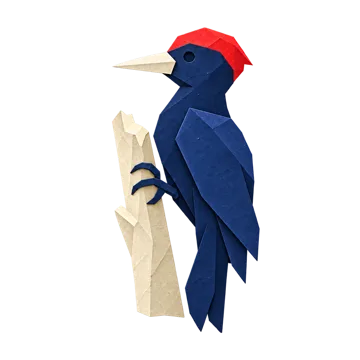
Europe's largest woodpecker, all black; the male has a bright red crown, the female a red patch on the nape. It lives in the great beech and fir forests of the montane zone, where it carves large holes. Once abandoned, these holes shelter Tengmalm's owls, bats and even martens.
Deep in a beech and fir forest in the Jura, a ringing call carries far between the trunks, then sharp knocks echo. Clinging to an old trunk, an all-black bird, as big as a crow, sends wood chips flying: a black woodpecker.
Description
No woodpecker in Europe is larger. Black all over, it has a pale bill and eye. Red tells the sexes apart: the male has it over the whole top of the head, the female only on the nape. According to the Swiss Ornithological Institute, it measures 40 to 46 cm, with a wingspan of 64 to 68 cm and a weight of 300 to 350 g. Its flight is undulating.
Habitat
It seeks out large forests with old trees, open enough to fly through, and above all beech and fir forests, according to the Swiss Federal Research Institute WSL. It carves its holes at least 4 m above the ground, in a smooth, branchless trunk, preferably a beech a hundred years old or more; a pair has 8 to 10 of them over about 1 km². The Swiss Breeding Bird Atlas records it mainly from 400 to 1700 m, most numerous between 900 and 1500 m, especially in the Jura and the Prealps; it has nested as high as 2200 m, near the Pass dal Fuorn.
Way of life
It searches stumps, dead wood and trunks for ants, including their larvae and pupae, and for insects that live in the wood or under the bark, mainly bark beetles and longhorn beetles. Sedentary, it does not leave its forest. The female lays 4 to 6 eggs, incubated for 12 to 14 days; the young fledge after 24 to 28 days. Once abandoned, its large holes take in the pine marten, the jackdaw, the stock dove, tawny and Tengmalm’s owls, then starlings, edible dormice, bats, hornets and wild bees.
In Switzerland
The Ornithological Institute puts the population at 7000 to 12,000 pairs (2025); the species is not threatened. Its numbers have almost doubled since 1990, especially between 400 and 1000 m, and it settled in Geneva in 1996, then in the Mendrisiotto in 2003. According to the Atlas, it is thought to benefit from the conifer plantations carried out from the 19th century onwards, which favoured wood ants, but also from older forests, more dead wood and perhaps milder winters, as harsh winters take a heavy toll on it. The WSL advises keeping nest-hole trees and patches of old-growth wood for it.
Sources: Swiss Ornithological Institute, species account and text of the Swiss Breeding Bird Atlas 2013–2016; Swiss Federal Research Institute WSL and Swiss Ornithological Institute, factsheet “Le pic noir” [The black woodpecker] (waldwissen.net).