Translated from French with the help of AI; the French text prevails.
Rock ptarmigan
Rock ptarmigan
Lagopus muta
Zone
Alpine
Altitude
1900–3000 m
Active period
all year
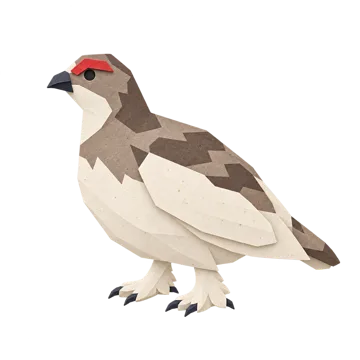
A plump bird with white wings that changes its plumage with the seasons: speckled with grey and brown in summer, all white in winter, it blends first with the rocks, then with the snow. It lives in the meadows and scree of the alpine zone. Its feathered feet work as snowshoes.
On a ridge, well above the last trees, a snowball starts trotting between two boulders. Without that movement, no one would ever have noticed it: it is a rock ptarmigan in its winter dress.
Description
This gamebird of the grouse family measures 34 to 36 cm, with a wingspan of 54 to 60 cm and a weight of 400 to 600 g, according to the Swiss Ornithological Institute. It is the only bird in the country that changes colour with the season: white in winter, except for the tail, with a black stripe through the eye in the male; mottled grey-brown in summer, more rufous in the female, the wings staying white. A red comb sits above the eye. Feathered down to the toes, its feet carry it over the snow almost without sinking in, the Swiss National Park notes.
Habitat
Unlike the other grouse, it lives in the open, among short, sparse vegetation, with stones, rocks and scree for shelter. According to the Breeding Bird Atlas, it mainly occupies heaths and grasslands from 2000 to 2800 m, and the highest nest was found at 2980 m. It rarely settles in places that are wooded, overgrown with scrub or crossed by pistes. It is a relic of the ice ages: in Scotland, in the Pyrenees and in the Alps, its populations have remained cut off from those of the far north.
Way of life
It eats buds, leaves, berries and seeds. In winter it feeds quickly and a lot, then rests out of the cold in a hole dug in the snow, where it stays put for long spells in bad weather. Every flight forced on it by a skier or a hiker costs it energy it may pay for with its life. It nests on the ground; the year’s single clutch has 5 to 9 eggs, which hatch after 21 to 24 days, and the chicks can fly at around ten days old.
In Switzerland
The Ornithological Institute puts the population at 10,000 to 18,000 pairs (2025). The species is near threatened and a priority for conservation, and 40% of the ptarmigans of the Alps live in Switzerland. At 40 sites monitored from 1995 to 2012, the decline reached 13% in all. By pushing the forest upwards, the warming climate takes space away from it; near Aletsch, it declined markedly between 1970 and 2015 in the areas taken over by the arolla pine. Winter sports also disturb it: it can be helped by staying on marked routes and out of wildlife rest zones.
Sources: Swiss Ornithological Institute, species account, text of the Swiss Breeding Bird Atlas 2013–2016, press release “La situation se complique pour le lagopède” [Things are getting harder for the ptarmigan] (2023) and article “Maître du camouflage” [Master of camouflage]; Swiss National Park, rock ptarmigan factsheet.