Translated from French with the help of AI; the French text prevails.
Spotted nutcracker
Spotted nutcracker
Nucifraga caryocatactes
Zone
Subalpine
Altitude
1000–2200 m
Active period
all year
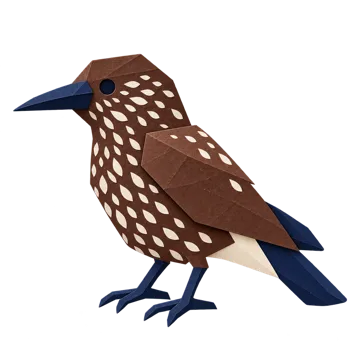
A brown bird spangled with white spots, with a strong, pointed bill. It lives in the arolla pine and spruce forests of the subalpine zone. In autumn it hides thousands of arolla pine seeds in the ground and finds most of them again, even under snow: the forgotten ones grow into new arolla pines.
In autumn, at the top of an arolla pine, a brown bird speckled with white wedges a cone into a crack and pulls out its seeds. Then it flies off, its crop full, towards the slope opposite: the spotted nutcracker is laying in its stores.
Description
This member of the crow family, a cousin of the magpie and the alpine chough, is the size of a jay: 32 to 33 cm, a wingspan of 49 to 53 cm and 160 to 250 g, according to the Swiss Ornithological Institute. Its chocolate-brown plumage is scattered with white spots; wings and tail are black, the tail edged with white at the tip. The bill, black like the legs, measures about 4 cm according to the Swiss National Park. Male and female look alike.
Habitat
It lives in the Alpine arc and the western Jura, in coniferous forest, sometimes mixed with broadleaved trees, provided it has hazels or arolla pines within reach, and its reach is wide: 15 km, sometimes more. According to the Breeding Bird Atlas, neither walnuts, nor chestnuts, nor acorns can replace these seeds. It is therefore abundant where the arolla pine is abundant: in the centre and south of the Grisons, and in the valleys of southern Valais.
Way of life
Its autumn harvest is spread across thousands of caches, buried a few centimetres deep. According to the Swiss National Park, it finds about 80% of them again, even under snow, though no one knows how. These stores feed it in winter and are also used to raise the young. The forgotten seeds sprout: the arolla pine depends on it to spread, and even to take root above the last trees. It nests in a tree; a single brood a year, of 3 or 4 eggs incubated for 18 to 21 days, and the young fledge after 23 to 25 days.
In Switzerland
The Ornithological Institute puts the population at 17,000 to 30,000 pairs (2025); present all year round, it is not threatened and its numbers have held steady since the end of the last century. It is gaining a little ground between 1800 and 2300 m, where the forest is reclaiming abandoned alpine pastures, but becoming scarcer between 700 and 1700 m, perhaps because of forests closing up, woodland edges without shrubs and the warming climate. The Swiss National Park has made it its emblem; yet it was once persecuted, accused of harming the arolla pines.
Sources: Swiss Ornithological Institute, species account, text of the Swiss Breeding Bird Atlas 2013–2016, article “Bien nommé cassenoix moucheté” [The aptly named spotted nutcracker] and project page on the dispersal of arolla pine seeds; Swiss National Park, factsheets on the spotted nutcracker and the arolla pine.