Translated from French with the help of AI; the French text prevails.
Edelweiss
Edelweiss
Leontopodium alpinum
Zone
Alpine
Altitude
1800–3000 m
Position
Mostly on the adret
Flowering
July – September
Its flowers are ringed by white, woolly, star-shaped bracts covered in hairs that shield them from strong sun and from drying out. It grows on dry, rocky limestone grassland, mostly on sunny slopes. It became a symbol of the Alps and was picked so heavily that it is now protected.
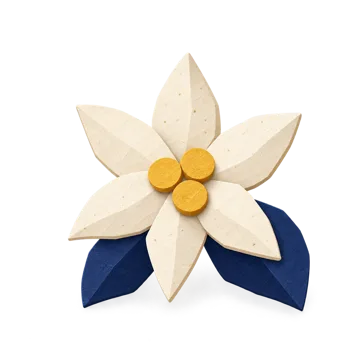
On a limestone slope in full sun, between the stones and the short grass, a small star of greyish white, as if cut out of felt, catches the eye: an edelweiss.
Description
From 3 to 20 cm tall according to Info Flora, it is woolly from the stem to the leaves, which are narrow and 5 cm long at most. Its “flower” is in fact a bouquet. In the centre, two to ten small yellowish heads gather tiny tube-shaped flowers, 50 to 500 in all according to Presence Switzerland; around them, five to fifteen bracts covered in thick white down open into a star. This fleece softens the sun’s rays, and the still air it traps limits water loss, the Swiss National Park explains.
Habitat
The edelweiss seeks out limestone. Info Flora places it on rocks and in stony grassland, mainly in the alpine zone, from dry blue moor-grass turf to wind-exposed ridges. The Swiss National Park locates it on sun-facing slopes, and not above 3000 m. Outside the Alps, it grows only on La Dôle, in the Jura. Yet it comes from far away: from Siberia and the Himalayas, Presence Switzerland reports, and it is said to have reached the Alps during an ice age.
Life cycle
A perennial, it spends the cold season with its buds at ground level. It flowers from July to September, then produces achenes, small dry fruits about 1 mm long. Growers have raised it at low altitude since the 1990s, and it turns up ever more often in gardens.
In Switzerland
The name edelweiss, “noble white” in German, only caught on in the mid-19th century, when the Alpine clubs adopted the flower as their emblem. Tourists and climbers then picked it as a souvenir, to the point that it disappeared from some places, according to the Swiss National Park. As early as 1878, Obwalden banned pulling up its roots, one of the first laws of its kind in Europe. The Confederation does not protect it, but Info Flora lists eleven cantons that protect it fully and three partially. Not threatened in Switzerland, it is rated vulnerable in the Jura by the Red List. Army generals even wear it on their insignia.
Sources: Info Flora, species account; Swiss National Park, edelweiss factsheet and document “Anpassung der Alpenpflanzen an ihren Lebensraum”; Presence Switzerland (Federal Department of Foreign Affairs), article “The mystical and mythical edelweiss”.