Translated from French with the help of AI; the French text prevails.
Western jackdaw
Western jackdaw
Coloeus monedula
Zone
Colline
Altitude
200–1200 m
Active period
all year
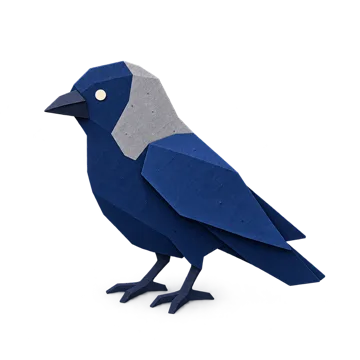
A small black crow with a grey nape, a pale eye and a short dark bill. It nests in colonies in church towers, old walls and valley cliffs, rarely above 1200 m. Not to be confused with the alpine chough, its yellow-billed cousin of the summits: altitude alone often tells them apart.
Round an old church tower, a band of black birds wheels, giving short, high “tchak” calls: western jackdaws. Up close, you know them by their grey nape and above all by their eye, a grey so pale it looks white in that dark face. Males and females wear the same plumage. It is a modest-sized crow: according to the Swiss Ornithological Institute, 33 to 34 cm from bill to tail and a wingspan of 64 to 73 cm. In flight, its wings beat fast.
The jackdaw is a lowland bird. Most pairs live on the Swiss Plateau and in the Jura, below 600 m. A few climb the great Alpine valleys, as far as Brig in Valais and Riom in the Grisons, whose castle, at 1230 m, now holds the country’s highest colony. You can see it all year round: many stay put, the others do not go far. It feeds on the ground where the grass is short, and eats almost anything.
To nest, it needs a hole. It finds one in old buildings and chimneys, on limestone or molasse cliffs, and even in trees: of all the crow family, it alone takes to tree holes, often those the black woodpecker dug and then left. Pairs live in colonies; the one at Hallwyl castle, in Seengen, Aargau, gathers up to 80 pairs. A clutch holds 3 to 6 eggs, incubated for 17 to 18 days, and the young fledge after 30 to 35 days.
With an estimated 1200 to 1700 pairs in 2025, the species is still rare here: the Red List classes it as near threatened, and it is one of the priority species for conservation. Yet the effort is paying off. Where colonies are monitored every year, numbers have grown by about 40%, thanks to protection projects and to measures taken on buildings, especially when they are renovated. A nest box only really helps if the colony has meadows to feed in within easy reach.
Sources: Swiss Ornithological Institute, species account and text of the Swiss Breeding Bird Atlas 2013–2016.