Translated from French with the help of AI; the French text prevails.
Great yellow gentian
Great yellow gentian
Gentiana lutea
Zone
Subalpine
Altitude
1000–2500 m
Flowering
June – August
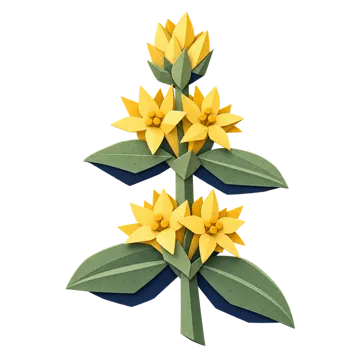
A tall plant that can top one metre, with yellow star flowers stacked in tiers along the stem above broad, ribbed leaves. It grows in pastures and flowers only after nearly ten years. Its bitter root is distilled into a mountain spirit and liqueurs.
In July, on a pasture in the Jura, tall stems rise well above the grazed grass. At each tier, a cluster of yellow stars nestles in the hollow of two broad, bluish leaves: the great yellow gentian is in flower.
Description
According to Info Flora, its hollow, unbranched stem measures 50 to 120 cm; swissinfo even mentions 150 cm for the tallest. The leaves come in pairs, facing each other, without stalks. Bluish green and 5 to 15 cm wide, they are lined with five to seven prominent veins that meet at the tip. The flowers gather in groups of three to ten against the upper leaves. Their yellow corolla splits into five or six narrow strips 2 to 3 cm long, joined only at the base and spread open in a star.
Habitat
It is a plant of limestone. Info Flora describes it in mountain pastures and rich meadows, from the montane to the subalpine zone, in the Alps, the Prealps and the Jura. According to swissinfo, it thrives at around 1000 m on the limestone soils of the Jura Arc, of which it has become the emblem.
Life cycle
The great yellow gentian takes its time. According to swissinfo, it can live some fifty years and flowers only after about ten. Its flowering then runs from June to August. Underground, its bitter root can reach 1.5 m in length and 10 cm in thickness, and weigh 5 kg, even 7. A remedy known since antiquity, it is dug up, with a hooked pick and by hand, only once the plant has reached seven to ten years of age.
In Switzerland
The Red List does not consider it threatened in any region of the country. The Confederation does not protect it, but twelve cantons do, nine of them fully, according to Info Flora. Its root is also used to make a spirit, and Neuchâtel provides the oldest Swiss mention of it, in 1796. To obtain between 5 and 7 litres of this spirit, about a hundred kilos of root must be distilled; fewer than ten distilleries, in the Jura or the Prealps, still produce it, swissinfo reports. The spirit is nicknamed the “yellow fairy”, a nod to the colour of the plant’s flowers.
Sources: Info Flora, species accounts for the great yellow gentian and white false hellebore (after Flora Helvetica); swissinfo.ch, “La gentiane, la fée jaune du Jura suisse”; Lyon Poison Control Centre, Toxicologie analytique et clinique, 2023.