Translated from French with the help of AI; the French text prevails.
Red squirrel
Red squirrel
Sciurus vulgaris
Zone
Colline
Altitude
200–2000 m
Active period
all year
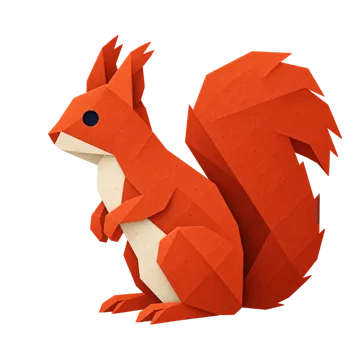
A small red rodent with a bushy tail and, in winter, tufted ears. It lives in every forest, from lowland parks to the arolla pines at the tree line. In autumn it hides seeds and hazelnuts and forgets some of them: that is how it plants part of the forest.
Cone scales rain down on the path. On a spruce branch, a squirrel strips its meal at top speed, then dashes off and leaps into the next tree. At the foot of the trunk, only frayed cores remain.
Description
At about 300 g, it is among the largest rodents in the country. It is identified by its bushy tail and the tufts of hair on its ears; among our wild animals, only the lynx has similar ones, Waldwissen.net notes. These tufts are renewed only once a year, after the spring moult, and some squirrels keep remnants of them into the summer. The coat ranges from bright red to brown, or even black; the belly stays white.
Habitat
It needs trees, from lowland forests to mountain conifer woods; in the Swiss National Park, it is abundant in the coniferous forests, where it gnaws the cones of spruce and arolla pine. The ideal is a mixed forest with a closed canopy and dense undergrowth. It spends almost all its time up in the trees. Its nest, a ball of twigs lined with grass and moss, is wedged against the trunk, usually 5 to 10 m above the ground.
Way of life
Active only by day, it does not hibernate. In autumn it gathers cones, hazelnuts and other seeds, which it buries at the foot of trees or tucks into a hollow trunk; it even hangs mushrooms in a fork to dry them. Its memory of its hiding places is imprecise: in winter, on fine days, it searches the spots where it usually buries its stores, even if that means emptying those of a neighbour or a jay. Some caches are forgotten, and these help to spread the trees’ seeds. The female gives birth to two to five young, once or twice a year; it is estimated that only one in four or five reaches the age of one.
In Switzerland
Not threatened, it is protected everywhere and all year round by the Hunting Act. The danger may come from the south: introduced into Italy, the American grey squirrel lives in Lombardy, on the banks of the River Ticino, barely fifty kilometres from Switzerland. Heavier and more aggressive, it drives out the native species and passes a deadly virus on to it. According to Waldwissen.net, it had still not been reported in Switzerland at the end of 2024.
Sources: info fauna, species account; Swiss National Park, squirrel portrait; Waldwissen.net (WSL), “L’écureuil gris d’Amérique bientôt en Suisse ?” [The American grey squirrel soon in Switzerland?], “Comment les habitants de la forêt passent-ils l’hiver ?” [How do forest dwellers get through the winter?] and “Eichhörnchen – Kobolde im Wald” [Squirrels: goblins of the forest].