Translated from French with the help of AI; the French text prevails.
Alpine chough
Alpine chough
Pyrrhocorax graculus
Zone
Nival
Altitude
1500–4000 m
Active period
all year
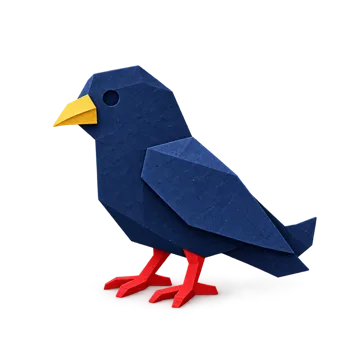
An all-black bird with a yellow bill and red legs, master of the air currents around the summits. It nests on cliffs up to over 3500 m and ventures higher still. At home around huts and mountain stations, it comes down to the valleys in winter.
At the summit, a flock of black birds bursts calling from a rock face, drops into the void, rises again on the wind and lands a few steps from the picnic. The alpine chough is black from head to tail; only its yellow bill and red legs, duller in the young, stand out. Nothing tells the male from the female. According to the Swiss Ornithological Institute, it measures 36 to 39 cm, with a wingspan of 65 to 74 cm and a weight of 180 to 270 g.
In Switzerland it lives only in the Alps, most numerous in their northern part. It raises its young on the rock faces of the alpine zone and returns there to roost all year round. The country’s highest known nest was built in the top station of the Klein Matterhorn cable car, above Zermatt, at 3820 m. To feed, it roams the alpine pastures and follows the melting snow; when snow covers everything, it comes down. In winter it makes the trip to the lowlands and back every day, ventures right into towns and returns to the mountains in the evening.
It eats almost anything: insects, fruit, mammals or birds, and whatever hikers and skiers leave behind. A pair raises only one brood a year: 4 or 5 eggs, incubated for 18 to 21 days, and young that fledge after 31 to 38 days. The alpine chough can live a long time: the oldest known in Switzerland was 23 years and 4 months old.
Switzerland has 11,000 to 21,000 pairs (2025 estimate), and the species is not threatened. Yet our country holds part of its future: 14% of Europe’s alpine choughs live here. The main danger comes from construction work for tourism. When a flower meadow or a grazed heath is reshaped into a ski slope, it grows poorer, and the bird loses a feeding ground.
Sources: Swiss Ornithological Institute, species account and text of the Swiss Breeding Bird Atlas 2013–2016.