Translated from French with the help of AI; the French text prevails.
Fireweed
Fireweed
Epilobium angustifolium
Zone
Montane
Altitude
300–2300 m
Flowering
June – September
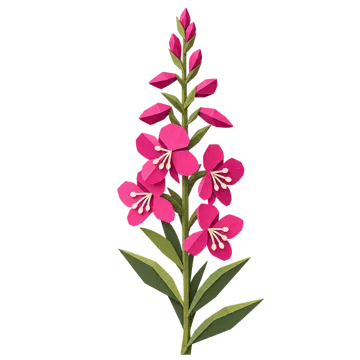
A tall plant with long spikes of magenta-pink flowers that colours clearings, felled woods and scree in summer. It quickly settles on bare ground after a windthrow or a fire. In late summer its seeds, carried on silky tufts, drift away by the thousand.
In July, where woodcutters have opened a gap in the forest, the ground has vanished under a sea of tall stems topped with bright pink spikes. A few weeks later, white flakes float above them: these are the seeds drifting off on their silky hairs.
Description
Fireweed, which Info Flora calls the narrow-leaved willowherb, measures 50 to 150 cm according to Flora Helvetica. Its straight, smooth stem bears many alternate leaves, narrow and pointed, 8 to 15 cm long, bluish underneath and with slightly rolled edges. The flowers, pink to purple, open in a long raceme at the top. Each has four rounded petals, up to 15 mm, four darker, slender sepals, a curved style and four stigmas that end up curling back into a star. The fruit is a finely downy capsule.
Habitat
Info Flora reports it throughout the country, from the colline to the subalpine zone, sometimes higher, in clearings, felled areas, scree and on banks. The plant association of clearings and felled areas on acid soil even bears its Latin name, Epilobion angustifolii. A pioneer plant, it takes advantage of every opening in the forest, whether it comes from felling, a storm or a fire.
Life cycle
A perennial, it flowers from June to August. According to the CREA Mont-Blanc factsheet, it sends up many shoots from its rootstock and so forms large flowering stands. At the end of summer, each plant releases countless tiny seeds, each with a tuft of silky hairs that lets the wind carry it away. In North America and Scandinavia, it dominates burnt, windthrown or felled forests for several years, researchers at the federal WSL institute point out; fittingly, English speakers call it “fireweed”.
In Switzerland
The Leuk fire, in Valais, showed it at work. Started on the evening of 13 August 2003, the fire destroyed more than 300 hectares and some 200,000 trees. The WSL monitored the recolonisation on 153 plots of 200 m². One year after the disaster, fireweed was already growing in nearly 60% of them, then in more than 90% from 2006 onwards; above about 1500 m, its stands covered hectares. The species is not threatened in any region of the country and enjoys no legal protection.
Sources: Info Flora, species account (after Flora Helvetica); CREA Mont-Blanc, Phénoclim factsheet for fireweed; WSL, page “Conséquences des incendies de forêts”; Wohlgemuth and Moser, “Phönix aus der Asche”, Bulletin de la Murithienne 126, 2009; Wohlgemuth et al., Merkblatt für die Praxis 46 on the Leuk fire, WSL, 2010; University of Zurich, database of medicinal and poisonous plants of the Institute of Veterinary Pharmacology and Toxicology.