Translated from French with the help of AI; the French text prevails.
Glacier crowfoot
Glacier crowfoot
Ranunculus glacialis
Zone
Nival
Altitude
2300–4270 m
Flowering
July – August
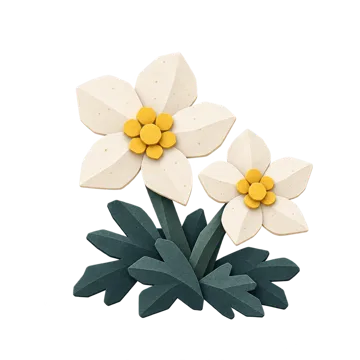
A small white flower with five petals that turn pink as they age, above fleshy leaves. It grows in damp scree and moraines near glaciers. It is one of the flowering plants that climb highest in the Alps: it has been found in bloom at 4270 m on the Finsteraarhorn.
At the snout of a glacier, where meltwater still seeps between the boulders, a few white flowers with yellow hearts stand low against the stones, some already tinged with pink: this is the glacier crowfoot.
Description
From 5 to 20 cm tall according to Info Flora, it carries one to five flowers 1.5 to 3 cm across on a stem that first lies flat and then rises. White when they open, they turn pink or purple as the fruits form; the Swiss National Park notes that this colour varies a great deal, and is sometimes missing. Its sepals, covered in reddish-brown hairs, do not fall once the flower has faded, and nor do the petals. The basal leaves, fleshy and usually hairless, are divided into three segments, which are themselves further divided.
Habitat
Info Flora lists it in siliceous scree, moraines and rock crevices, only in the Alps and from 2300 m upwards. It settles only on acid soil, for example on the Macun plateau, in the Swiss National Park. It seeks out damp places, well covered with snow in winter. Native to the Arctic, where it grows right down to the seashore, here it ranks among the flowers that climb highest.
Life cycle
It lives mostly underground. Botanists at the University of Innsbruck have observed that its leaves and flowering stems stay above ground for only a few weeks, when meltwater runs most freely, and that everything above the soil withers as soon as the seeds are ripe. Each flower starts to form two to three years before it opens: the plant thus keeps a stock of buds underground. In the nival zone, where it snows or freezes about one day in two, its reproductive cycle lasts almost twice as long and yields fewer seeds. According to the same university, it is the only known plant whose flower can freeze completely without damage.
In Switzerland
The Red List does not consider it threatened anywhere. No law, federal or cantonal, protects it, Info Flora points out. According to the Innsbruck study, most of its Alpine sites lie between 2400 and 3200 m, but it goes above 4000 m where the terrain offers it a favourable spot. The Swiss National Park records it up to 4270 m, on the Finsteraarhorn, and credits it with far more productive photosynthesis than lowland plants.
Sources: Info Flora, species account; Swiss National Park, glacier crowfoot factsheet; University of Innsbruck, S. Mauracher and J. Wagner, “Flower preformation in the nival plant Ranunculus glacialis L.”, Alpine Botany (2021), and article “Warum Pflanzen einfrieren, dabei aber nicht eingehen” (2019).