Translated from French with the help of AI; the French text prevails.
Black grouse
Black grouse
Lyrurus tetrix
Zone
Subalpine
Altitude
1400–2300 m
Active period
all year
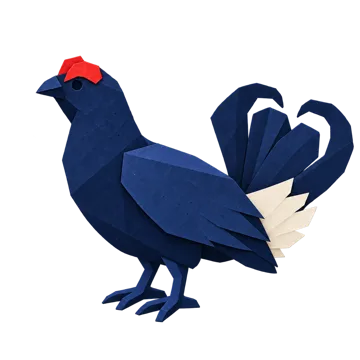
The cock is blue-black, with a red wattle above the eye and a lyre-shaped tail. It lives at the tree line, among sparse woods, alpenrose heaths and alpine pastures. In spring, at dawn, the cocks display together, cooing on their lekking grounds.
In spring, before dawn, where the forest ends, a cooing rises from a clearing still patched with snow. Several black cocks are challenging each other there in a dance, birds that are usually so secretive: the black grouse are in the middle of their mating season.
Description
The cock, black with a blue sheen, owes its French name, tétras-lyre, to its lyre-shaped tail; a bar on the wing and the underside of the tail are white. The hen, rufous brown and smaller, has a notched tail. According to the Swiss Ornithological Institute, the species measures 40 to 55 cm, with a wingspan of 65 to 80 cm and a weight of 750 to 1400 g.
Habitat
In Switzerland it is found only in the Alps and the Prealps, above all at the upper edge of the forests, where they meet the alpine pastures. According to the Breeding Bird Atlas, more than nine black grouse in ten live between 1400 and 2300 m; the highest known nest was at Tschlin (Grisons), at 2300 m, the lowest in the Centovalli (Ticino), at 1120 m.
Way of life
It feeds on plants and berries and does not leave its area. The hen lays 6 to 10 eggs on the ground, once a year; they hatch after 24 to 28 days, and the young can fly at 14 days. In winter, cold and scarce food force it to live frugally: it spends long hours in an igloo dug in the snow. If an off-piste skier drives it out, it has to make itself a new shelter by drawing on reserves that are already thin. If this happens again and again, the Swiss Federal Research Institute WSL explains, it breeds less successfully, grows weak, falls ill or ends up in a predator’s jaws.
In Switzerland
There are 12,000 to 17,000 cocks (Ornithological Institute, 2025); the species is near threatened and a priority for conservation. The count of displaying cocks, at its lowest in 1998, had almost returned to its 1990 level by 2016; the bird is gaining ground between 1900 and 2500 m and losing it lower down, and some leks have moved upwards. Yet the ski resorts lie at its altitude. In Valais, researchers from Bern calculated that off-piste skiing affects two thirds of its habitat, and that areas equipped with ski lifts hold on average half as many black grouse as similar sites. Since 2012, a canton can designate an area as a wildlife rest zone; keeping away from it spares the bird exhausting flights.
Sources: Swiss Ornithological Institute, species account, text of the Swiss Breeding Bird Atlas 2013–2016 and article “Des igloos pour l’hiver” [Igloos for the winter]; Swiss Federal Research Institute WSL, article “Le tétras lyre dans tous ses états” [The black grouse in every state] (waldwissen.net, 2013).