Translated from French with the help of AI; the French text prevails.
Bearded bellflower
Bearded bellflower
Campanula barbata
Zone
Alpine
Altitude
1200–2800 m
Flowering
June – August
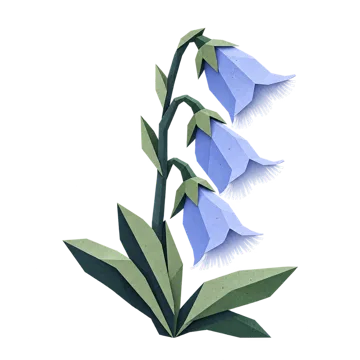
Its pale blue bells all hang to the same side of the stem, and their mouths are fringed with long hairs, like a beard. It grows in pastures and grassland on acid soils, from the tree line to the alpine zone.
In July, on a high pasture, pale blue bells all hang to the same side of their stem. Bending over one of them reveals a fringe of hairs at its mouth: the bearded bellflower lives up to its name.
Description
Stiff, rough hairs cover the whole plant. According to Info Flora, it measures 10 to 40 cm. Its leaves, lanceolate or oval and elongated, entire or barely toothed, are grouped mostly at the base; those on the stem are smaller. At the top, two to twelve nodding flowers line up on one side only. Each corolla forms a slightly swollen bell of 1.5 to 3 cm, pale blue, exceptionally white. Inside, its lobes bear curly hairs, the “beard” that gives it its name. Between the calyx teeth, small heart-shaped appendages fold backwards, against the tube.
Habitat
It avoids limestone. Info Flora records it in meadows and open woods, on soils that lack lime, and links it to the poor, acid pastures where matgrass grows. According to the University of Innsbruck, it also frequents cool or damp poor grassland and the edges of dwarf-shrub heaths. In Switzerland it is found in the Alps and the Prealps, mainly in the subalpine and alpine zones, more rarely from the montane zone upwards.
Life cycle
It flowers in July and August according to Info Flora, from June according to the University of Innsbruck. Its fruits are hairy capsules that stay nodding. Info Flora gives it two life forms: that of a perennial, which grows back each spring from buds at ground level, and that of a monocarpic plant, which dies after flowering a single time. It can also settle on new ground. In the European Phusicos project, carried out with the participation of the University of Geneva, researchers sowed various plants, paired with microbes selected in the laboratory, on the steep, unstable moraines left by the Gepatschferner glacier, in Austria’s Kaunertal, about 30 km from the Grisons. The bearded bellflower proved to be the species best able to stabilise those slopes, although mixed plant communities seemed more effective still.
In Switzerland
The Red List does not rate it as threatened in the country, but as vulnerable on the Swiss Plateau. The Confederation does not protect it, and only the canton of Glarus does, partially. It is one of the characteristic species named in the Environmental Objectives for Agriculture.
Sources: Info Flora, species account (after Flora Helvetica); University of Innsbruck, species account; University of Geneva, Campus no. 155, “La nature est appelée à l’aide” (2023).