Translated from French with the help of AI; the French text prevails.
Chamois
Chamois
Rupicapra rupicapra
Zone
Subalpine
Altitude
800–3000 m
Active period
all year
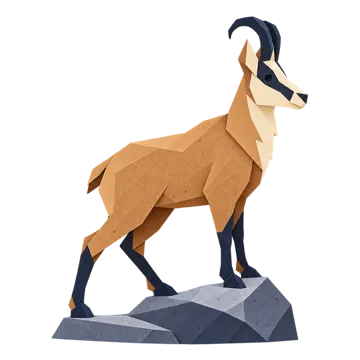
A nimble hoofed animal with a brown coat, a pale head barred with black stripes and short horns hooked at the tip. It lives on steep slopes and rocks around the tree line and moves down into the forest in winter. Its soft, splaying hooves give it a remarkable grip on rock.
The wind shifts, and the herd that was grazing at the foot of the rocks races off towards the scree. The chamois has seen nothing yet: it has scented the hiker. According to the Swiss National Park, an unfamiliar scent puts it to flight far faster than the sight of a silhouette.
Description
Both male and female have hooked horns, so alike that the sexes are hard to tell apart; in the female they are usually thinner and less curved. They are never shed and grow throughout life, and their rings give the animal’s age. The male weighs up to 45 kg, the female 35 kg, the Valais hunting service states. Its hoof, hard at the rim and soft in the centre, grips rock; it has even served as a model for mountain boots.
Habitat
It lives between forest and rock: cliffs, pastures, mountain woods. When threatened, it takes refuge on rock faces, in scree or among dwarf mountain pines. The males like the forest, where resin often sticks to their horns. Even in winter some can be seen up high, feeding on ridges the wind has swept clear or scraping the snow away with a hoof. It feeds on lichens, conifer needles, leaves, shoots and grasses.
Way of life
Females and their kids form herds all year round. During the rut, in November, the males chase each other relentlessly; on rare occasions a blow from a horn kills a rival. A gland behind the horns lets the buck mark branches with a scent all his own. After 26 weeks of gestation, the female gives birth to a single kid between mid-May and mid-June; the young one follows her everywhere from its very first steps. The lynx and the wolf hunt the chamois; the golden eagle mostly goes after the kids.
In Switzerland
The only ungulate never to have left the territory of the Swiss National Park, it played a part in the park’s founding; it has not been hunted there since 1920, and, depending on the year, 1000 to 1700 animals are counted there. The country is home to about 90,000 according to the Federal Hunting Statistics (as of 2025), and the species is not threatened. In Valais, though, where no ungulate is more widespread, it is declining in places. The canton cites many causes, from diseases and harsh winters to hunting, predators, livestock and leisure activities; the decline also affects protected areas.
Sources: info fauna, species account; Swiss National Park, chamois portrait; Valais Hunting, Fishing and Wildlife Service, factsheet “Le chamois” [The chamois] (2025); Waldwissen.net (WSL), “La statistique fédérale de la chasse” [The federal hunting statistics].